

NHS organisations are being asked to hit efficiency targets of between 1.6% and 11% this year. More than half say they won’t get there.
In the same twelve months, general practice lost 470 full-time equivalent partners. That was part of a decline of 6,397 FTE partners since 2015.
You already know the numbers feel wrong. This article is about why, and what to do about it.
Underneath the headlines lie three crises. The first is a funding shortfall that threatens primary care’s basic viability. The second is a system that misjudges what primary care is worth. The third is a partnership model that is failing faster than most people will admit.
A real opportunity exists within this context. The opportunity lies in the government’s 10 Year Health Plan and the shift toward neighbourhood-based care. Whether that opportunity gets taken is still up for grabs.
The Funding Crisis: Beyond the Headlines

For general practice, the NHS needs an extra £8.5 billion a year for the next four years. This is to close a £32 billion funding gap. Primary care has taken more than its share of the pain.
Moreover, the Darzi report found that primary care’s share of NHS spending fell by a quarter over about a decade. It dropped from 24% in 2009 to 18% in 2021, continuing a decline that began in 2004. We’re doing more of the work for a shrinking slice of the budget.
In general practice, the 2025/26 GP contract looked like good news. It offered a 7.2% increase to core funding, the biggest rise in over a decade.
Most of it disappeared quickly. Higher minimum wage costs and increased employer National Insurance contributions ate into it immediately.
NHS England’s own estimate of the real-terms increase was 4.8%. The 2026/27 contract, published in February 2026, showed the increase as a 3.6% cash uplift and 1.4% in real terms. Less than a third of the year before.
Whatever ground the 2025/26 settlement clawed back, it wasn’t held.
The Partnership Crisis: A System Under Siege
GP partner numbers in England have dropped by around 25% over the past decade. Salaried GP numbers have risen by 86% in the same period and now make up 49% of the workforce.
Between June 2024 and September 2025 alone, FTE partner numbers fell by 4.1%. The number of partners under 40 fell by 17%.
Look at the age profile, and the trajectory gets harder to ignore. In September 2025, only 10.5% of the partner workforce was under 40, roughly half the proportion a decade earlier. The proportion over 60 rose from 9.4% to 15.5% over the same period. We are heading toward a point where partners retire faster than anyone is training to replace them.
Ask trainees why they’re avoiding partnership and the answers are consistent. In the 2024 GP trainee survey, workload responsibility was cited by 64% of respondents. This was up from 56% in 2019. Financial commitment put off 60%. Administrative workload was flagged by 75% of trainees, nearly double the 49% who said the same in 2019.
The BMA reports a steady rise in the proportion of practice income swallowed by expenses. This rise leaves less for partner drawings. This creates a cycle that is hard to break. Rising costs squeeze partner income in general practice, making partnership less attractive. Fewer people take it on, and the workload and financial pressure on the remaining partners grow heavier.
Are Partnerships Dynamics also Struggling?
Workload and finances are the part that show up in the survey data. It’s rarely the whole story of why a partnership actually breaks down. I’ve written elsewhere about the five needs that hold a general practice team together. They are autonomy, belonging, compassion, identity, and psychological safety. Watch a partnership come apart under financial strain and it’s rarely the money itself that ends it. It’s autonomy going first, a partner who no longer has a real say in decisions that affect them, followed by belonging and psychological safety once the working relationship reshapes itself around what’s gone unsaid. The financial pressure is real and it’s the trigger. What actually determines whether a partnership survives it is whether the structure underneath still meets those five needs once the pressure hits. A practice that’s built for that holds together under strain that would break one that hasn’t.
The Value Proposition Crisis: What Is Primary Care Worth?
Here’s the question underneath the funding crisis: how do you put a number on what primary care actually does for a population’s health? Everyone agrees primary care matters. Almost nothing about how it’s funded reflects that.
Primary care’s strength is that it treats the whole person, medical, social and environmental factors together. That’s also exactly what makes it hard to measure using tools built for disease-specific care. The system rewards what it can count, and it can’t count continuity, holistic judgement, or the value of catching something early.
The Alignment Problem: A Three-Way Disconnect
There’s a three-way mismatch sitting at the centre of this.
GPs want time to deliver the kind of comprehensive, relationship-based medicine they trained for. Commissioners want efficiency measured in disease-specific outcomes and patient volume. Patients want care that makes sense in the context of their actual lives, with continuity and someone who can help them navigate a complicated system.
Nobody’s demand is unreasonable. But the three don’t line up, and everyone ends up losing something. GPs burn out chasing incompatible targets. Commissioners watch costs climb without matching outcomes. Patients get care that treats their diagnosis rather than them.
The Neighbourhood Health Revolution: Opportunity Amidst Crisis
The government’s 10 Year Health Plan commits to shifting spend away from hospital care toward out-of-hospital care over the next three to four years, with neighbourhood health centres at the centre of that shift. That’s not a minor policy adjustment. It’s the most significant structural change to how care is organised since the NHS was founded.
These centres are meant to bring hospital-based services, diagnostics, post-operative care, rehabilitation, into the community, eventually running 12 hours a day, six days a week. Alongside the clinical services, they’re meant to house debt advice, employment support, and other help that has nothing to do with medicine and everything to do with health.
Evidence from Early Adopters
This isn’t theoretical. In Derby, integrated neighbourhood teams cut category 3 ambulance callouts by 2,300 and short hospital stays among the over-65 population by 1,400, in a single year. From September 2025, the government began working with 42 selected sites to accelerate this model, prioritising areas with the lowest healthy life expectancy.
What’s missing from the plan is any clear statement on where existing GP practices sit inside it. Will practices be absorbed into neighbourhood centres, or run alongside them? Nobody has answered that yet, and the uncertainty is real for partners who’ve built their careers and their finances around the current model. There’s also a live question about private sector involvement in funding these centres, with a decision expected at the 2025 autumn budget. What that means for GP autonomy and the partnership model is still unclear.
Strategic Solutions for an Optimistic Radical Future
You don’t have to wait for the funding model to fix itself before you act. A few things are already working.
Portfolio roles are broadening what practices can offer, with a catch worth naming. Frailty clinics, functional illness clinics, dermatology, diabetes, menopause: these have grown because they meet real clinical need and because disease-specific work is what payers currently reward.
For 2025/26, the Additional Roles Reimbursement Scheme was expanded and recruitment caps removed, giving PCNs full control over who they bring in. That’s genuinely useful.
It’s also being used in a way that cuts against the portfolio-role argument: in a Pulse survey of 315 GP partners, around 40% said their PCN was considering replacing non-GP ARRS staff with GPs, and 16% had already done it or started to. Removing the cap on GP hiring means some PCNs are using their new flexibility to hire more GPs instead of the physiotherapists, pharmacists and paramedics that made multidisciplinary teams multidisciplinary in the first place.
If you want portfolio roles to work as a retention lever, that only holds if the variety survives. Building the team wide, not just building it, is the part that takes deliberate effort now.
The data we collect doesn’t capture what primary care actually does. QOF measures disease-specific outcomes. It says nothing about early intervention, continuity, or the time GPs spend coordinating care that never shows up on a spreadsheet. Worth being precise here: England mandated SNOMED CT as the single clinical terminology across the NHS back in 2018, so EMIS and SystmOne aren’t going to be replaced by something else any time soon.
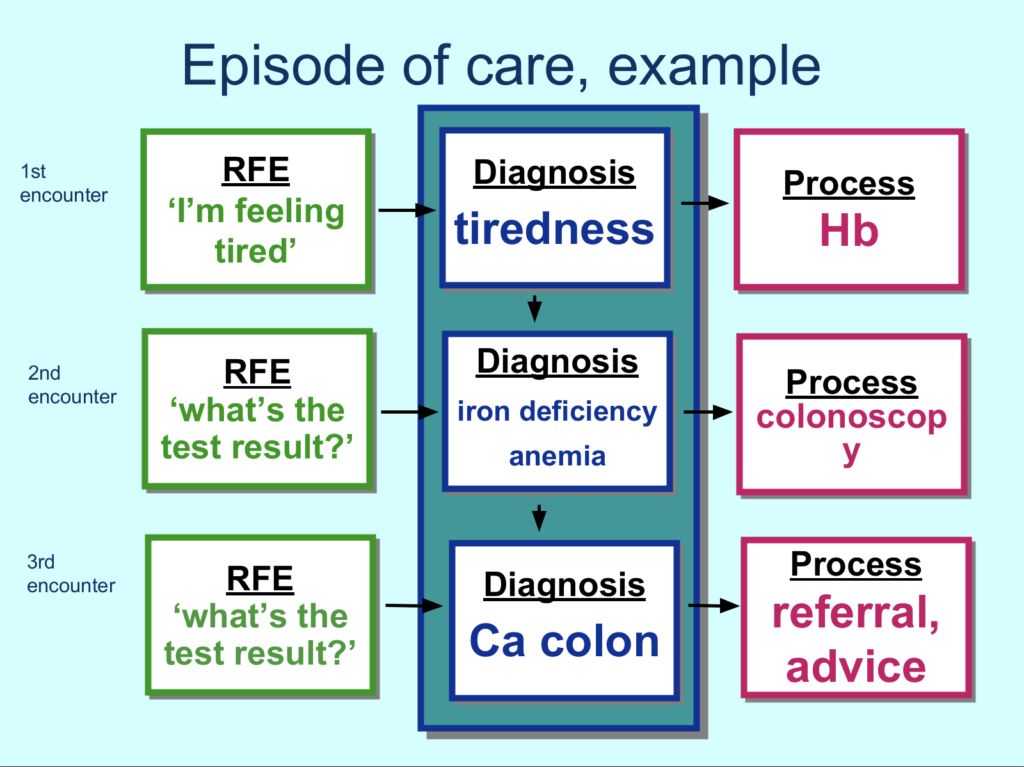
The International Classification of Primary Care (ICPC), used in the Netherlands, Belgium and Australia, does something SNOMED CT doesn’t do well: it structures reason for encounter, problems managed, and episodes of care in a way built specifically for general practice rather than hospital statistics. We’re not switching systems. But the gap ICPC points to is real, and it’s worth naming precisely: SNOMED CT can record what you coded, but it was never designed to capture why the patient came in, or how one consultation connects to the next as an episode. Coding better within the system we’ve got, and pushing NHS England to build reason-for-encounter and episode structure into SNOMED CT’s primary care use, would still make early intervention, coordination time and continuity visible in a way QOF is not achieving right now. It’s a smaller ask than a new coding system. It’s also one that’s actually achievable.
Practical Implementation
Standardising consultation systems around a continuity framework would:
Reward early intervention: Capture the value of general practitioners identifying and managing conditions before they require specialist care, reducing downstream costs and improving outcomes.
Recognise administrative work: Code the substantial time primary care clinicians spend on care coordination, documentation, and system navigation—currently invisible and unrewarded.
Improve care continuity: Track episodes of care across multiple consultations, demonstrating the value of longitudinal relationships.
Enable data-driven resource allocation: Collecting this data supports quality improvement initiatives by enabling tracking of health outcomes and effectiveness of interventions over time, allowing healthcare providers to expands ways to identify patterns and implement evidence-based strategies.
By integrating these coding priorities with existing QOF indicators, we create a comprehensive funding model that values both disease-specific outcomes and the broader contributions of primary care. This data would demonstrate to commissioners, policymakers, and the public exactly what primary care delivers and what it costs to deliver it well.
Appointment Management
Appointment management is a skill, not an afterthought. The 2025/26 contract updates the capacity and access payment and expands online consultation tools so patients can submit requests any time during core hours. But availability isn’t the whole story. Matching the right patient to the right clinician at the right time takes real investment in demand and capacity modelling, triage systems, and flexible staffing. Practices that get this right free up capacity without adding headcount, and the current funding model still doesn’t reward that expertise properly.
Training for Tomorrow: Aligning Education with Reality
Training has to catch up with where general practice is actually going. We’ve fallen well short of the pledge of 6,000 more GPs by 2024, and the number of fully qualified FTE GPs in England keeps falling. This isn’t only a recruitment problem. It’s a retention problem that starts in training. We’re asking trainees to prepare for a partnership model that’s shrinking, without properly preparing them for the neighbourhood-based, integrated model that’s replacing it. No wonder so many leave training uncertain about what comes next.
Fixing that means rebuilding parts of the curriculum: longer placements across a wider range of general practice settings, practical teaching on practice finance, leadership and the business of running a practice rather than treating it as an afterthought, real skills in multidisciplinary working and population health, and portfolio career thinking built in from year one rather than discovered by accident five years post-CCT.
Most of all, it means telling trainees the truth: It’s among the most demanding, complex, and genuinely important job in medicine, and trainees deserve to hear that from the people teaching them.

What 2035 could look like
A funding model that reflects what primary care actually contributes to individual health, population health, and system cost, not just disease-specific targets. Neighbourhood health systems mature enough that patients experience one coordinated journey instead of a string of disconnected episodes. A workforce where partnership is something people choose because it’s viable, not something they avoid because it isn’t. And a feedback loop, built on real data, that lets the system keep adjusting rather than repeating the same mistakes for another decade.
None of that happens by itself.
Policymakers need to move past rhetoric and commit to real funding reform, understanding that primary care investment is the most effective money the NHS spends, while protecting what already works during the transition to neighbourhood care. Commissioners and ICBs need to back innovative funding approaches.
Practice leaders don’t need to wait for a perfect system: portfolio roles, specialised clinics, and closer PCN partnership are available now, and sharing what works and what doesn’t will get everyone there faster. Educators need to rebuild GP training around where the job is actually heading, not where it used to be, while still making trainees proud of the speciality they’re choosing. And if you’re early in your career, the way you engage with this now matters. Build a portfolio career on purpose rather than by accident. Consider partnership. Lead a QI project. Say, out loud, what your work is actually worth.
General practice in 2035 will look nothing like it does today. Whether that’s transformation or collapse depends on what gets built in the next few years, not what gets said about it.
If you’re a few years into training or just past CCT and partnership looks like a trap rather than a goal, you’re reading the data correctly. Fewer than a third of GPs now say they’re likely to consider it. But look at what GPs who’ve ruled it out actually say would change their mind: better organisational and administrative support, and more certainty over workforce availability, not more money. Both of those are things a well-run PCN can build before the funding formula changes. Testing out practices will tell you more about whether partnership is worth it than any national survey will.
If you’re already a partner, the honest read of this piece is that none of the practice-level fixes here fix the funding formula. They’re what you control while you wait for someone else to fix the part you don’t. Portfolio roles, better appointment management, and pushing your ICB on how SNOMED CT captures continuity are all real levers, and all of them are more useful applied deliberately than adopted because everyone else is doing it. Pick one. Do it properly. Don’t wait for the neighbourhood centre question to resolve itself before you start.
A Call to Action
Primary care is too important to fail and too easy to overlook. The version of 2035 worth building is one where general practice stops being the part of the NHS nobody quite knows how to value, and becomes the part everyone can see is working. That future is within reach—if we have the courage to build it.
What would you change first?
Read our article on 3 Strategies for a Stronger Primary Care Workforce.
References:
STANGE, K.C., MILLER, W.L. and ETC, R.S. (2023). The Role of Primary Care in Improving Population Health. The Milbank Quarterly, 101(S1), pp.795–840. doi:https://doi.org/10.1111/1468-0009.12638.
Parr, E. (2024). Inflation forced NHS England to Cut Primary Care Funding Last Year. [online] Pulse Today. Available at: https://pulsetoday.co.uk/news/practice-personal-finance/inflation-forced-nhs-england-to-cut-primary-care-funding-last-year/ [Accessed 10 Dec. 2025].